
As a roofing company owner, you’re constantly bombarded with marketing advice. “You need SEO!” “You should be running Google Ads!” But rarely does anyone explain how these two powerful strategies work together to create something greater than the sum of their parts.
In today’s competitive digital landscape, relying on just one marketing channel is like trying to build a roof with only hammers and no nails. Google’s 2025 shift to AI-powered ad placement and organic ranking synergy makes understanding this relationship more crucial than ever for roofing contractors looking to grow their businesses.
Let’s dive into how SEO and Google Ads can work together to create a full-funnel marketing strategy that delivers both immediate visibility and long-term organic growth.
Key Takeaways
-
Complementary strengths: SEO builds long-term authority while Google Ads delivers immediate visibility. According to Google Ads Insights, businesses using both see 25-30% higher click-through rates and 50% higher brand lift compared to using either strategy alone.
-
Full-funnel approach: Google Ads captures high-intent searchers ready to buy now, while SEO builds trust with researchers still in the consideration stage. Together, they cover every stage of the customer journey.
-
Data sharing benefits: Running both strategies simultaneously provides valuable keyword insights that can improve performance across both channels. Your Google Ads data reveals high-converting keywords to target in your SEO efforts.
-
Increased SERP real estate: Appearing in both organic and paid results can double your visibility for important keywords, giving you an edge over competitors who focus on just one approach.
-
Cost optimization: As your SEO rankings improve, you can strategically reduce or reallocate Google Ads spending, creating a more sustainable marketing model that reduces customer acquisition costs over time.
Why Should Roofing Companies Use Both SEO and Google Ads?
They Target Different Stages of the Customer Journey
When a homeowner discovers a leak or storm damage, they typically don’t immediately hire the first roofing company they find. Instead, they follow a journey from awareness to research to decision. SEO and Google Ads excel at different points in this journey.
Google Ads shines at capturing immediate needs. When someone searches “emergency roof repair near me” after discovering water dripping from their ceiling, they need help now. Your ads appear instantly at the top of search results, putting you ahead of organic listings. This immediate visibility is perfect for capturing high-intent, ready-to-convert leads.
Meanwhile, SEO builds authority and trust over time. It excels at educating homeowners who are researching options, comparing materials, or learning about maintenance. These longer-form, informational searches typically happen earlier in the customer journey.
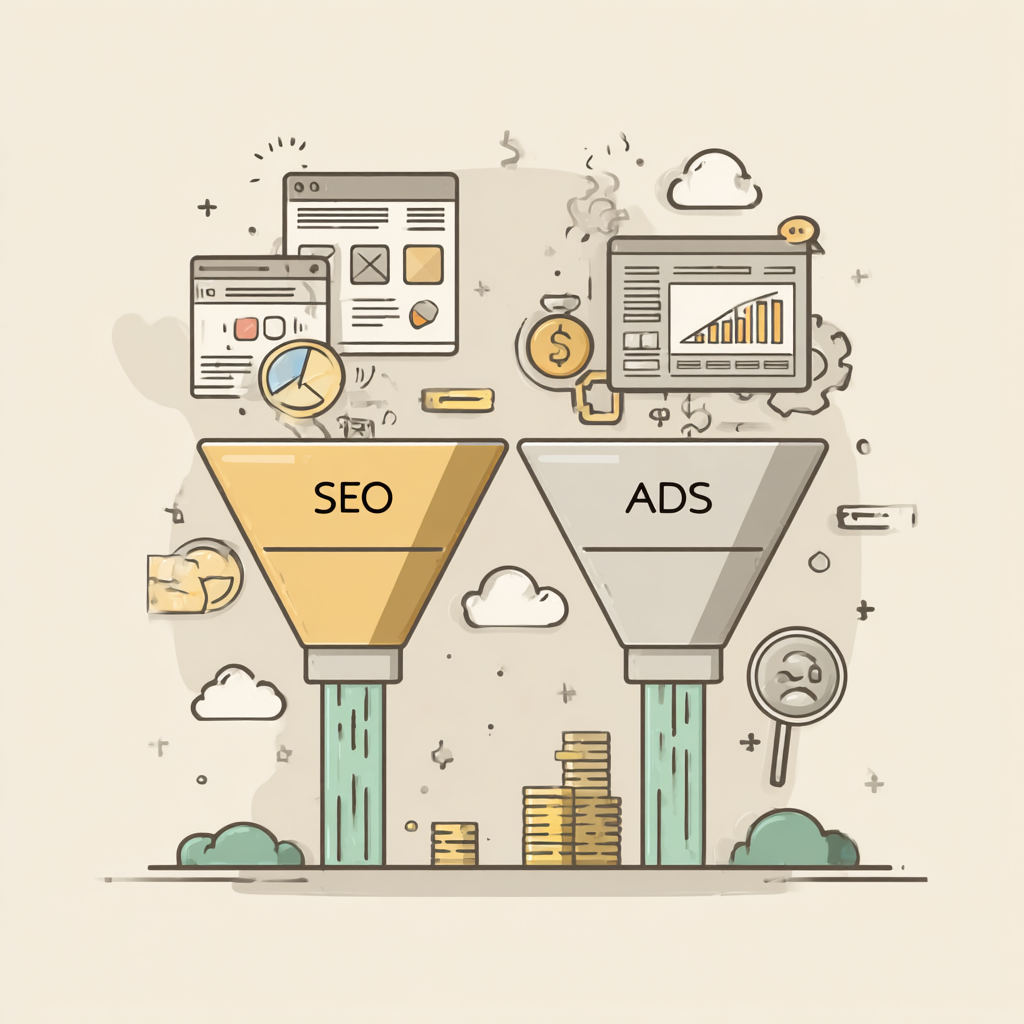
Together, these strategies create a complete funnel:
- Top of funnel: SEO captures research-phase homeowners with educational content
- Middle of funnel: Both SEO and Google Ads keep your brand visible during comparison shopping
- Bottom of funnel: Google Ads captures urgent needs and high-intent searchers ready to hire
This complementary approach ensures you’re present at every stage of the decision-making process. According to Google Ads Insights benchmark data, businesses using both SEO and Google Ads see 25-30% higher click-through rates and 50% higher brand lift compared to using either strategy alone.
| Customer Stage | SEO Role | Google Ads Role |
|---|---|---|
| Awareness | Educational blog content, guides | General brand awareness campaigns |
| Consideration | Service pages, comparison content | Specific service highlighting ads |
| Decision | Reviews, testimonial content | “Near me” and emergency service ads |
| Post-Purchase | Maintenance guides, warranty info | Remarketing for referrals/reviews |

How Do SEO and Google Ads Improve Each Other’s Performance?
They Share Data That Makes Each Channel Stronger
One of the most powerful aspects of running both SEO and Google Ads is the data synergy between the two channels. Each strategy generates valuable insights that can be used to strengthen the other.
Google Ads provides immediate keyword performance data that would take months to gather through SEO alone. This data includes:
- Conversion rates by keyword: Discover which specific terms actually drive leads
- Geographic performance insights: Learn which neighborhoods or ZIP codes respond best to your messaging
- Ad copy effectiveness: Test different messaging approaches quickly
- Customer intent signals: Understand where people are in the buying journey
Here’s how this data sharing works in practice:
- You test different headline variations in your Google Ads
- You discover that ads mentioning “storm damage inspection” convert 40% better than generic “roof repair” ads
- You apply this insight to your SEO content strategy, creating more storm damage-focused content
- Your organic traffic becomes more targeted and more likely to convert
This data-sharing advantage works in the opposite direction as well:
- SEO content performance: Discover which blog topics generate the most engagement and apply those themes to ad copy
- Organic search query data: Identify new long-tail keyword opportunities for your ad campaigns
- Content gaps: Find topics where competitors are ranking but you aren’t, then target those with ads while building SEO content
- User behavior insights: Learn which pages visitors engage with most, then direct ad traffic to high-performing pages
According to research from Marketing Hub Daily, businesses that actively use data from both channels to inform their overall strategy see an average 37% improvement in conversion rates compared to those that keep these strategies separate.
For roofing companies specifically, this data synergy is particularly valuable when targeting seasonal opportunities like storm damage, ice dam prevention, or fall maintenance inspections. You can quickly test messaging through ads, then build that successful approach into your content marketing strategy.
Why Should Roofing Companies Run Both SEO and Google Ads?
The Combined Strategy Addresses Unique Industry Challenges
The roofing industry faces specific challenges that make the SEO and Google Ads combination particularly effective:
High-Value, Low-Frequency Purchases
Roof replacements are high-ticket items ($8,000-$25,000) that homeowners purchase infrequently (every 15-30 years). This creates a marketing challenge: you need to be visible at exactly the right moment when a homeowner decides they need a roof.
- SEO alone: You might rank well, but miss the immediacy needed when someone has storm damage
- Google Ads alone: You’ll capture urgent needs but miss long-term research and planning phases
- Combined approach: You’re visible throughout the entire customer journey—from research to emergency needs
Geographic Targeting Precision
Roofing is hyper-local, and the combined approach gives you more precise geographic targeting:
- SEO builds local authority through consistent content, citations, and Google Business Profile optimization
- Google Ads provides immediate presence in specific neighborhoods after storms or in areas with aging homes
- Together, they create comprehensive local visibility that’s difficult for competitors to match
Seasonal Demand Fluctuations
The roofing industry has pronounced seasonal patterns, which the combined approach addresses perfectly:
- Peak season strategy: During spring and summer busy periods, scale up Google Ads to capture immediate demand while your SEO continues building long-term authority
- Off-season strategy: Reduce ad spend during slower winter months while your SEO continues working, then create targeted ad campaigns around winter-specific issues like ice dams or attic ventilation
Competitive Differentiation
In competitive markets, the combined approach helps you stand out:
- Paid positions showcase your unique selling propositions (financing options, warranties, etc.)
- Organic listings establish your expertise and authority through educational content
- The presence in both spaces creates a perception of market leadership
Here’s a seasonal approach to budget allocation that works well for most roofing companies:
| Season | SEO Budget | Google Ads Budget | Focus Keywords |
|---|---|---|---|
| Spring | 40% | 60% | “roof inspection,” “spring roof maintenance” |
| Summer | 30% | 70% | “emergency roof repair,” “storm damage roof” |
| Fall | 50% | 50% | “roof replacement before winter,” “gutter cleaning” |
| Winter | 70% | 30% | “ice dam prevention,” “roof snow removal” |
This approach ensures you’re investing appropriately based on seasonal demand while maintaining the foundation of your digital presence year-round.
For more specific guidance on seasonal content creation, check out our guide on SEO for roofers: mastering content creation for peak season.
What’s the Ideal Budget Split Between SEO and Google Ads?
Finding the Right Balance for Your Roofing Business
There’s no one-size-fits-all answer to budget allocation, but there are strategic frameworks that can help you find the right balance for your specific business situation.
For most roofing companies, the ideal approach follows what we call the “Growth Stage Model” — your budget allocation should shift based on your business maturity and goals:
Startup Phase (1-3 years in business)
- Google Ads: 70-80% — Focus on immediate lead generation and building initial customer base
- SEO: 20-30% — Begin building foundation with citation building, Google Business Profile optimization, and basic website content
Growth Phase (3-7 years)
- Google Ads: 50-60% — Continue driving leads while becoming more targeted and efficient
- SEO: 40-50% — Expand content strategy, build authority in specific service categories, and focus on local search dominance
Mature Phase (7+ years)
- Google Ads: 30-40% — Highly targeted campaigns for specific services and neighborhoods
- SEO: 60-70% — Comprehensive content strategy, authority building, and competitive dominance
Your allocation should also consider your current situation:
- Need immediate leads? Shift toward Google Ads temporarily
- Strong referral base already? You may be able to invest more heavily in SEO
- Entering a new service area? Lead with Google Ads while building SEO for the region
- Facing aggressive competitors? You may need to increase both simultaneously
According to SEO.com, businesses that strategically balance both channels see an average ROI improvement of 30-45% compared to those that focus exclusively on one channel.
Quick Budget Calculator Template:
This simplified calculator can help you determine a starting point for your budget allocation:
Monthly Marketing Budget: $______

Allocation Factors (Score each 1-5):
- Need for immediate leads: ___ (Higher = more Google Ads)
- Geographic competition level: ___ (Higher = more of both)
- Brand awareness in market: ___ (Higher = more SEO)
- Seasonal factor (peak = 5, off-peak = 1): ___ (Higher = more Google Ads)

Calculate:
- If total score is 8-12: 60% Google Ads, 40% SEO
- If total score is 13-16: 50% Google Ads, 50% SEO
- If total score is 17-20: 40% Google Ads, 60% SEO
Remember that this allocation should be reviewed quarterly. Analyze performance data from both channels and adjust accordingly. The most successful roofing companies maintain flexibility in their allocation, responding to seasonal trends, competitor movements, and their own growth goals.
For more insights on building your overall marketing approach, read our comprehensive guide on How to build your roofing marketing strategy.
What Are the Most Effective Ways to Integrate SEO and Google Ads?
Practical Implementation Strategies for Roofing Companies
Now that we understand the value of combining these strategies, let’s look at specific implementation tactics that create true integration:
1. Keyword Alignment and Reinforcement
The foundation of integration is consistent keyword targeting across both channels:
- Identify your highest-converting keywords from Google Ads
- Create SEO content clusters around those same terms
- Use ad copy insights to inform title tags and meta descriptions
- Target difficult-to-rank terms with ads while building SEO authority
Implementation Example:
If your Google Ads data shows “emergency roof leak repair [city]” converts well but is highly competitive for organic rankings, create a comprehensive content strategy around that topic while maintaining visibility through ads.
2. Geographic Conquest Strategy
Leverage both channels to dominate specific neighborhoods:
- Identify high-value zip codes based on home values and roof ages
- Create neighborhood-specific landing pages optimized for local SEO
- Run targeted Google Ads campaigns to those same neighborhoods
- Develop neighborhood-specific offers that appear in both organic and paid listings
Implementation Template – Neighborhood Conquest Plan:
Target Neighborhood: [Name]
Demographics: [Age of homes, income level, etc.]
Specific Pain Points: [E.g., recent storm damage, older roofs, specific housing styles]

SEO Strategy:
- Create neighborhood-specific landing page
- Develop 2-3 supporting blog posts about local roofing challenges
- Build local citations mentioning this neighborhood
- Pursue links from neighborhood associations or community websites

Google Ads Strategy:
- Create neighborhood-specific ad group
- Include neighborhood name in headlines
- Highlight familiarity with local building types
- Use location targeting to focus budget on this area

Measurement:
- Track rankings for "[neighborhood] + roofing" terms
- Measure impression share for neighborhood-focused ads
- Track leads by neighborhood source
For more on dominating local searches, check out Local SEO for Roofers: Your Guide to Dominating Local Searches.
3. Seasonal Campaign Integration
Create seamless seasonal campaigns across both channels:
- Develop quarterly themes relevant to your climate
- Create SEO content around seasonal topics 60-90 days before peak demand
- Boost with Google Ads during peak seasonal interest
- Capture data on highest-converting seasonal terms for next year’s planning
Example Seasonal Integration Calendar:
| Timing | SEO Action | Google Ads Action |
|---|---|---|
| Jan/Feb | Publish content about spring maintenance and winter damage | Low budget, focused on maintenance terms |
| March | Publish storm preparation content | Begin scaling budget for spring season |
| April-June | Publish summer protection and heat damage content | Peak budget, focus on repair and inspection |
| July-Sept | Publish fall preparation and winter-proofing content | Strong budget, begin targeting replacement |
| Oct-Nov | Publish emergency winter repair and ice dam content | Reduced budget, target remaining replacement |
| Dec | Create new content calendar for coming year | Minimal budget, focus on emergency terms |
4. Remarketing Integration
Create a seamless experience for prospects across both channels:
- Identify high-value organic visitors (those who visited key service pages)
- Create remarketing audience segments based on service interest
- Develop ad creative that acknowledges their previous interest
- Provide next-step content to move them through the buying journey
For example, if someone reads your organic content about “signs you need a new roof,” show them remarketing ads about “scheduling a free roof inspection” or “understanding roof replacement costs.”
This integrated approach creates a more cohesive experience for potential customers while significantly improving conversion rates. According to a case study from Diffuse Digital Marketing, businesses that implemented this type of integrated remarketing saw conversion rates increase by 37-49% compared to those using standard remarketing.
5. Landing Page Optimization for Both Channels
Develop landing pages that serve both organic and paid traffic effectively:
- Create comprehensive service pages that thoroughly address customer needs (good for SEO)
- Include clear calls-to-action and conversion elements (good for ads)
- Ensure fast loading times and mobile optimization (critical for both)
- Implement structured data to enhance organic listings while maintaining clean design for ad traffic
By building landing pages that work for both channels, you maximize efficiency and create a consistent user experience regardless of how prospects find you.
For more details on how Google Ads work specifically for roofing companies, read What are Google Ads and how do they work for roofing companies?
How Can You Measure the Combined Impact of SEO and Google Ads?
Tracking Success Beyond Single-Channel Metrics
When you run integrated SEO and Google Ads campaigns, traditional single-channel metrics don’t tell the complete story. To truly understand performance, you need to measure how these channels work together.
Here are the key metrics and measurement approaches for tracking integrated performance:
1. Cross-Channel Attribution Reporting
Standard last-click attribution misses the interplay between channels. Instead, implement:
- Multi-touch attribution: Track how users interact with both organic and paid touchpoints before converting
- Assisted conversions report: See how each channel supports conversions in the other
- Attribution modeling comparisons: Compare different models (first-click, linear, position-based) to understand the customer journey
Setting up Google Analytics 4 with proper conversion tracking is essential for this analysis. The goal is to understand how exposure to one channel influences performance in the other.
2. Search Impression Share Analysis
Measure your total visibility in search results:
- Organic visibility: Track rankings and impression data from Google Search Console
- Paid impression share: Monitor what percentage of eligible ad auctions you’re appearing in
- Combined impression share: Calculate your total visibility across both channels for key terms
This analysis helps you identify gaps in your overall search presence and opportunities to increase total visibility.
3. Brand Lift and Awareness Metrics
Measure how the combined approach enhances overall brand recognition:
- Brand search volume: Track searches for your company name over time
- Direct traffic growth: Monitor increases in people directly searching for your site
- Social listening metrics: Track mentions of your company across social platforms
- Branded vs. non-branded conversion rates: Compare how these different traffic types perform
According to research from UM Marketing, businesses running integrated campaigns see brand search volume increase 38% faster than those running single-channel campaigns.
4. ROI Calculation Template
Here’s a simplified template for calculating true ROI across both channels:
Period: [Month/Quarter]

Channel Costs:
SEO Investment: $______
Google Ads Spend: $______
Total Investment: $______

Channel Revenue:
Direct SEO Conversions: $______
Direct Google Ads Conversions: $______
Assisted Conversions (influenced by both): $______
Total Revenue: $______

ROI Calculation:
Combined ROI: (Total Revenue - Total Investment) ÷ Total Investment × 100 = ____%
The key is including assisted conversions that happen when someone interacts with both channels during their buying journey.
5. Competitive Search Landscape Analysis
Regularly analyze how your integrated approach compares to competitors:
- SERP feature ownership: Track which search features (ads, organic, local pack, etc.) you own versus competitors
- Share of voice: Estimate your total search visibility compared to competitors
- Keyword gap analysis: Identify terms where competitors are visible in both paid and organic but you’re missing one channel
This competitive analysis helps you identify strategic opportunities to increase your overall search presence relative to competitors.
By implementing these measurement approaches, you’ll gain a much clearer picture of how your SEO and Google Ads efforts work together to drive results. This data-driven approach allows you to continuously refine your strategy and maximize your marketing ROI.
If you’re ready to see how your current SEO performance stacks up, get a free SEO audit to identify your biggest opportunities.
Wrapping Up: The Future of SEO and Google Ads for Roofing Companies
The relationship between SEO and Google Ads is more important than ever for roofing companies looking to grow in 2025 and beyond. Google’s continued evolution toward AI-driven search results makes having multiple visibility channels not just beneficial but essential for sustainable growth.
When implemented correctly, the combination of these strategies creates a powerful marketing engine that addresses the unique challenges roofing companies face—seasonal demand, geographic targeting needs, and high-value but infrequent purchases.
The data is clear: businesses running both SEO and Google Ads see 25-30% more clicks and 50% higher brand lift compared to running either strategy alone (Source: Google Ads Insights, 2024). This synergy creates compounding benefits that go beyond what either channel could achieve independently.
As you plan your marketing strategy for the coming year, resist the temptation to view these as competing options. Instead, consider how they can work together to create a comprehensive search presence that captures demand throughout the entire customer journey.
Ready to see how your current strategy stacks up? Get a free SEO audit to identify your biggest opportunities and develop a roadmap for integrating these powerful marketing channels.
FAQs About SEO and Google Ads for Roofing Companies
Q: If I have limited budget, should I start with SEO or Google Ads?
A: Start with Google Ads while building SEO foundations. With limited budget, Google Ads provides immediate visibility and data about which keywords convert best. Use that performance data to inform your SEO strategy as you begin building it. Allocate about 70-80% to Google Ads initially, then gradually shift toward a more balanced approach as your organic visibility increases.
Q: How long does it take to see results from the combined approach?
A: Google Ads results appear within days, while SEO takes 3-6 months for significant impact. The benefit of the combined approach is immediate visibility through ads while your SEO builds momentum. Most roofing companies see Google Ads conversions within the first week of a well-structured campaign, while SEO typically shows measurable traffic increases around month 3-4 and significant lead generation improvements by month 6.
Q: How do I know if my SEO and Google Ads strategies are actually working together effectively?
A: Look for increasing brand searches, improving quality scores, and cross-channel assisted conversions. Effective integration shows up in several metrics: increasing searches for your business name, improving quality scores in Google Ads (as SEO content supports ad relevance), lower cost-per-click over time, and growing numbers of conversions that involve touchpoints from both channels in Analytics attribution reports.
Q: Will running Google Ads help my SEO rankings?
A: Not directly, but indirectly yes through increased brand searches and engagement signals. Google has stated that paying for ads doesn’t directly influence organic rankings. However, effective ads increase brand awareness, which leads to more branded searches and higher click-through rates on your organic listings—both positive ranking signals. Additionally, ads drive traffic to content that might otherwise receive limited visibility, creating engagement signals that can indirectly benefit SEO.
Q: How should I adjust my combined strategy during the slow winter season for roofing?
A: Reduce Google Ads budget while maintaining SEO momentum through winter-specific content. During slower periods, scale back Google Ads spend by 40-60%, focusing remaining budget on emergency repairs and maintenance terms. Meanwhile, use this period to build out comprehensive SEO content about winter-specific issues (ice dams, attic ventilation, winter inspections) and general educational content that will support next year’s busy season. This approach maintains visibility while controlling costs during low-demand periods.
Q: Is it better to use the same keywords for both SEO and Google Ads, or should I target different terms?
A: Use a strategic mix—overlap on high-value terms and differentiate where appropriate. For your most valuable converting keywords (usually service-specific terms like “roof replacement [city]”), maintain presence in both channels for maximum visibility. For highly competitive terms that are difficult to rank organically, prioritize Google Ads while building SEO authority. For informational topics where ads typically convert poorly, focus on SEO content. This balanced approach ensures comprehensive coverage while allocating budget efficiently.
Table of Contents
Keep on learnin'
Related Articles

The Synergy Between Google Ads, SEO, and ROI: A Roofing Company’s Guide


How to Track Where Your Leads Come From: A Guide for Roofing Contractors